This is very important meeting and is Dr Bhaskaran’s annual visit to us. He is one of our most ardent supporters. Find out about what’s going on in our area plus GP and PCN News.
Please come to our next meeting: 13th October 2026 2-4pm
All are welcome to our monthly meeting. We have a different speaker each month, with a few favourite speakers returning and some interesting new speakers. Plenty of chat about your diabetes and other things, information, a raffle and tea & biscuits.
If you’re interested please come along as our guest, your first visit is free.
13th October 2026- Our Speaker this month is Dr Baskaran NHS Annual visit-
Dr Binodh Bhaskaran- NHS PCN Diabetes area clinical director.
He says, “In my role as Clinical Director, I am committed to addressing the population needs of our PCN by working collaboratively with member practices and community providers to improve health outcomes for all our residents”. His Special Interests: Diabetes Area Lead, Orthopaedic & Musculoskeletal Diseases.
This is very important meeting and is Dr Bhaskaran’s annual visit to us. He is one of our most ardent supporters. Find out about what’s going on in our area plus GP and PCN News.
Diabetes health checks (annual review) What To Expect
Diabetes can cause other health problems that can become serious if not picked up and monitored or treated in the early stages. So regular diabetes health checks – sometimes called your yearly or annual review – are part of your routine NHS treatment.
What diabetes health checks should I be getting?
As part of your annual review, these are the health checks you should be offered:
A blood test where enough blood is taken to be sent to the lab to check your:
HbA1c your average blood sugar levels for the past three months
Your healthcare team will also ask if you smoke, so you can be offered help to stop.
It may not be at your annual review appointment, and is likely to be done by a different team, but you should also be invited to:
A diabetic eye check this is not the same as a sight test at the optician. Photos are taken of your eyes to see how diabetes is affecting them, as it can damage the blood vessels and cause an eye problem called diabetic retinopathy.If your last diabetic eye check was clear, it may be safely offered once every two years rather than once a year.
If you’ve been finding it hard to manage your blood sugar levels, be kind to yourself. Rather than being tempted to skip your health checks, see appointments as an opportunity to be as honest as you can with your healthcare team – and ask for help.
Early treatment can help prevent or lower your risk of serious health problems from high blood sugar levels. These include sight loss, toe or leg amputations, kidney disease, heart attack and stroke.
So it’s important to get all of your health checks. See below the most common diabetes heath checks people miss out on – and tips to make sure you get them.
Diabetes health checks people are more likely to miss out on
People are less likely to have their urine check for kidney disease, eye check and foot check than the other diabetes health checks.
It can be difficult to access your annual review or diabetes health checks appointments – but as routine NHS care, it’s something that GPs and hospital teams should have set aside time for. So don’t feel guilty about chasing up appointments. They are there to help you and your team monitor how diabetes is affecting other parts of your body and help keep you healthy.
There are also other reasons why people may not get these health checks. Find out some of these reasons and see our tips to help you get these checks:
Providing a urine sample to check for kidney disease
Lots of people miss out on this check because providing a sample of your wee isn’t always easy.
You might be sent a bottle to wee into at home, or have to provide a sample on the day of the appointment. Some people find this stressful but also a bit messy. Equally, carrying around a urine sample all day if you’re going to work isn’t practical.
Tips to make providing a urine sample easier
Ask the healthcare professional doing the check for flexibility. If you need something bigger to wee into or if you’d rather take the bottle home, do ask.
You should also make sure the lid is on safely and could try wrapping tissue around the sample bottle or putting it into sealed bag if you are worried about it spilling.
Sally, who has type 2 diabetes: “I don’t want to carry the urine sample around in my bag at work all day, so I do it at the surgery. I’ve started using the toilet they have upstairs so I don’t have to walk through the waiting room with it.”
Getting a diabetic eye check
Lots of people miss out on this check because the diabetic eye check appointment is usually done at different clinic and not at your GP surgery or hospital.
So, you may feel uncomfortable seeing someone new, or having to travel to a place you don’t know. Some people may also worry about the results of the eye check more than other tests.
You also won’t be able to drive after your appointment as you’re often given eye drops to help make the photo of your eyes clearer, which can make them blurry for a while afterwards.
But it is important to get this check to see if diabetes is affecting your eyes so you can get treatment to delay or prevent it affecting your sight.
Tips for making sure you get a diabetic eye check
Remember that this isn’t a sight test, so you won’t have the expense of buying new glasses, if this is worrying you.
It’s important to think about how to get to and from your appointment especially as you won’t be able to drive afterwards. If the appointment is hard to get to by public transport, check with the eye check provider or GP if there are other clinics that may be easier to get to even if they’re further away.
And if you’re unsure about the check itself or going to a new place, ask a neighbour, friend or relative to go with you.
If you aren’t getting diabetic eye check appointments, you should contact your GP or hospital team. They can refer you to your nearest eye check service. If you are housebound, you should ask them how you can access these appointments in a way that’s accessible to you.
“Having my eyes checked prevented me losing my sight as problems with a build-up of fluid around my retina and issues with my blood vessels were caught early. I was able to get treatment before any lasting damage.
James Baillie, who has type 1 diabetes
Getting a foot check
Sometimes there may not be enough time at your annual review appointment for a foot check to be done. And sometimes you may worry about your feet not being as clean or smelling as you’d like.
Tips for making sure your feet are checked
If there isn’t time for a foot check, do insist on a follow-up appointment. It isn’t enough for you to have checked them yourself.
If you’re worried about someone touching your feet remember the person checking your feet is a trained professional and has seen it all and they will not mind.
When you attend appointments, it can speed things up if you wear something that’s quick and easy to take off and put back on. So, for example wear socks instead of tights and shoes that are easy to remove.
“The GP asks if I’ve noticed any changes in my feet, if I say no, they don’t check them. So unlike the blood test results, I don’t feel confident that there aren’t any problems. I feel too embarrassed to ask if they can do a foot check,” John, who has type 2 diabetes.
Other possible reasons people may not get their diabetes health checks
Having to repeat the checks
Sometimes it can be frustrating if you are asked to have the same checks at a hospital diabetes service and at your GPs.
To stop this happening, if your check-ups are done by your hospital team, you’ll need to ask your hospital team to send the information to your GP. And ask your GP to add any test results from the hospital to your records.
Fear of being judged
If you don’t get on with your healthcare professional – or feel they judge you, then it can be difficult to attend your appointments. Ask if it is possible to see a different healthcare professional for your diabetes health checks. If that’s not possible, but your relationship with the person doing the checks is preventing you from going, then think about whether you want to change your GP practice.
Worry about starting medication
The thought of having to start medication for diabetes can be worrying for some people, especially if they have read about the side effects. But there are now several different types of medications for type 2 diabetes so if you are having side effects or don’t like how the medication is making you feel, you should talk to your diabetes team about what medications may be best for you.
Prioritising other things above your health
It can be hard to make time for your health checks, especially if you are not sure why they are important. Busy lives can mean you prioritise work, family or other life pressures. But we know that diabetes related health problems can come on quicker in younger people so it’s important to take time out to make sure your health is being looked after.
If you have diabetes, there is other NHS care available if you need or want it. There are also certain checks and appointments that you should have when you’re first diagnosed – see below.
Everyone living with diabetes should have certain checks and appointments when they’re first diagnosed with diabetes, to make sure you understand your condition and can live well with diabetes. If you didn’t have any of these when you were first diagnosed, speak to your healthcare team.
Everyone living with type 1 or type 2 diabetes should have:
A full assessment of your medical history, and anything going on in your personal life that might affect your diabetes.
A referral to a diabetes group education programme that works for you and your cultural background, or the same type of education in a one-to-one appointment if you prefer. This should be within a year of diagnosis if you live with type 1 diabetes.
Within six months of being diagnosed with type 1 diabetes, you should have:
An individual diabetes management plan, discussed and agreed on with your healthcare team, that works for you and your cultural background, including your personal targets, contact details for your diabetes team and follow-up plans.
Detailed information on how to live well with type 1 diabetes including giving your insulin, counting carbohydrates, managing hypos, managing when you’re ill, physical activity, and DVLA requirements for driving.
A review with a dietitian.
Your antibodies measured to confirm your diagnosis if it’s not clear what type of diabetes you have.
When you’re diagnosed with type 2 diabetes, you should have:
If it’s right for you, a discussion about weight management or weight loss and type 2 diabetes remission, which is when your average blood sugar levels are no longer in the range for diabetes and you don’t need medication.
A review of your emotional wellbeing and mental health needs.
A review of your medication.
A summary of your agreed diabetes management plan and when it should be reviewed again.
NHS care to expect if you need it
There are some diabetes checks and appointments that you should have access to but not everyone will need. Speak to your healthcare team if you think you need any of this help but aren’t getting it.
Everyone with diabetes should have access to:
An HbA1c check every three to six months if you’re struggling to meet your targets.
The chance to meet and get support from other people living with diabetes.
Good quality care with access to diabetes specialists if you’re in hospital, including access to mental health support if needed.
Pre-pregnancy review if you’re planning to have a baby, and advice from specialists at least 12 weeks before stopping contraception.
Regular reviews at least every two weeks by the diabetes team during pregnancy.
A review of your emotional health and wellbeing needs.
A review and update of your management plan.
Appointments in a way that you prefer, whether that’s by phone or face to face, or reviewing your blood sugar levels with your healthcare team online, for example.
Specialists who can help you manage any diabetes complications.
Everyone living with type 1 diabetes should have access to:
A review of the diabetes knowledge you already have and would like to have,
Advice about your diet from a dietitian.
A thyroid function blood test.
A chat about diabetes technology offered locally that could help you. This includes continuous or flash glucose monitoring, which everyone should have access to if they would like it, or an insulin pump if you are not meeting your targets.
Support from specialists who can help you manage your medication and blood sugars around physical activity.
Everyone living with type 2 diabetes should have access to:
Support to lose weight if you want or need to.
Advice on physical activity.
Technology to monitor your blood sugar levels, like a continuous glucose monitor, depending on certain criteria.
You will also have access to other NHS care that is still important for your diabetes management, like flu and Covid-19 vaccines, screening services for other conditions, help to give up smoking, weight management support, and dental care
Some areas offer other opportunities to improve your general health and diabetes wellbeing, like weight management, organised physical activity and active community groups. Ask your healthcare team what other support is available to you.
What if I’m not getting the NHS care I need?
Sometimes it might be difficult to get the standard of care you should expect. If you don’t think you are getting the checks you should be, speak to your healthcare team. You could make a list of things from this page that you want to discuss with them, or order our free leaflet ‘What care to expect when you have diabetes’ to take along to your appointment.
If that doesn’t help, you may want to make a complaint. If you’re still not happy with the care you’re getting, you can ask for your diabetes care to happen at a different clinic or hospital. You can find out more by speaking to your healthcare team, or calling our helpline on 0345 123 2399.
Get a personal record of checks you’ve had and still need with our Diabetes Health Checks Planner on Learning Zone. Sign up first if you don’t have an account.
The Rother Neighbourhood Policing Team (NPTs) serves Bexhill, focusing on community engagement, high-visibility patrols, and tackling antisocial behaviour and drug-related crime.
Please come to our next meeting: 12th May 2026 2-4pm
All are welcome to our monthly meeting. We have a different speaker each month, with a few favorite speakers returning and some interesting new speakers. Plenty of chat about your diabetes and other things, information, a raffle and tea & biscuits.
If you’re interested please come along as our guest, your first visit is free.
JUNE MEETING- 6th June 2026 2-4pm
Neighbourhood Policing Team – Roy Collins
The Rother Neighbourhood Policing Team (NPTs) serves Bexhill, focusing on community engagement, high-visibility patrols, and tackling antisocial behaviour and drug-related crime.
Local Policing is organised into 3 divisions, each comprising Neighbourhood Policing Teams (NPTs) based within district teams. NPTs provide community engagement, foot patrols and assist local and partnership problem-solving.
NPTs are led by a District Commander and comprise sergeants, police officers and PCSOs.
These work with youth, licensing and enforcement officers. Also, investigators, specialists, and police staff within divisions and across Sussex Police support NPTs to protect communities and catch criminals.
Please come to the meeting, you’ll find it very helpful.
Proposal To Close the GP Practice on Sea Road in Bexhill
We also have Dawn Bamforth from NHS Sussex coming to talk to us about the proposed closure of the Sea Road Surgery. The objective is to explain the proposals and obtain members views on this difficult and possibly contentious proposal.
“Though a patient survey has already been completed, a decision on whether to approve this application has been paused until we are able to hear more from local residents about the effect this closure may have on them and whether there are any actions that could be taken to mitigate any negative impact.”
Contact: Dawn Bamforth | Working with People and Communities Manager
NHS Surrey and Sussex
This is a very important matter and I urge yo to come along and give your views
Podiatrists specialise in the assessment, diagnosis, and treatment of foot and ankle pathologies.They have expertise in various areas including, diabetes, wound care, musculoskeletal (MSK) foot and ankle conditions, nail surgery, as well as neurological, vascular and rheumatoid conditions.
14th October 2025 @ 2:00 pm – 4:00 pm
Dear Member,
Please come to our next meeting: 14th October 2025 2.00- 4.00pm
All are welcome to our monthly meeting. We have a different speaker each month, with a few favourite speakers returning and some interesting new speakers. Plenty of chat about your diabetes and other things, information, a raffle and tea & biscuits.
Our Speaker this month is Emma Diplock, HCPC Registered Podiatrist,First Contact Practitioner – Podiatry.
Podiatrists specialise in the assessment, diagnosis, and treatment of foot and ankle pathologies.They have expertise in various areas including, diabetes, wound care, musculoskeletal (MSK) foot and ankle conditions, nail surgery, as well as neurological, vascular and rheumatoid conditions.
Emma will discuss the care pathways, referral, how to help yourself and with self-referral and so on
Diabetes management
Managing foot complications related to diabetes, such as peripheral vascular disease (PVD), neuropathy and ulceration.
Wound care
Treating and managing chronic wounds and ulcers of the foot and ankle.
Musculoskeletal (MSK)
Providing care for a variety of issues relating to muscles, bones and joints.
Nail surgery
Performing minor surgical procedures to treat nail conditions such as ingrown toenails.
Orthotics
Providing and fitting custom orthotic devices to correct foot deformities and improve function.
Patient education
Advising patients on footcare, footwear choices, and preventative measures to maintain foot health.
As part of the Bexhill PCN they offer a highly Specialised Podiatrist service who can assess, diagnose and treat complex foot complaints. This can be anything from musculoskeletal foot complaints to the high-risk foot, general foot pain, wound care, in-growing toenails and general foot concerns.
Are you diabetic or worried about Diabetes? Come along to our afternoon open event at the Bexhill Bandstand on the Seafront, to share awareness of the Bexhill Diabetes Support Group, meet potential members and answer any questions.
DIABETES SUPPORT EVENT- Saturday 3rd May 2025 10am-2pmBexhill Coronation Bandstand
Open Support Event
Are you diabetic or worried about Diabetes? Come along to our afternoon open event at the Bexhill Bandstand on the Seafront, to share awareness of the Bexhill Diabetes Support Group, meet potential members and answer any questions.
We provide peer support to all people with diabetes and are all diabetes sufferers ourselves.
We can provide useful knowledge as well as good ideas to help our members manage their condition better with advice from interesting professional speakers at our regular monthly meetings.
The Committee try to theme each meeting. The Speaker giving a talk leading to a discussion on aspects of improving members diabetes lifestyle. There will be time for refreshments, raffle, chat and for you to raise issues you would like discussed.
The Committee offer a full programme, with a few favourite speakers returning and some interesting new speakers.
There is aways plenty of time to share knowledge and experience with fellow members at our meetings which can be very helpful, especially if you are struggling.
So, please pop into our event on Saturday 3rd May 2025 10am-4pm at: –
Bexhill Coronation Bandstand
De La Warr Parade
Bexhill-on-Sea
East Sussex
TN40 1LA
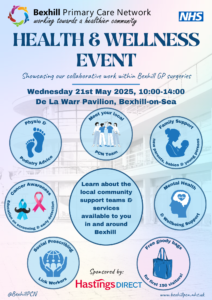
Come along to our free Health & Wellness Event and discover the care and support available to you in the Bexhill area on Wednesday 21st May from 10am to 2pm at the De La Warr Pavilion.
We will be attending this event at the De la Warr Pavilion.
Please come along if you can.
The Bexhill Primary Care Network (PCN) are here to help and support you alongside your GP surgery and local services to give practical support and information.
PCN’s bring GP Practices together with other local services such as community, mental health, social care and the voluntary sector to look after local populations.
Come along to our free Health & Wellness Event and discover the care and support available to you in the Bexhill area on Wednesday 21st May from 10am to 2pm at the De La Warr Pavilion.
Meet your local NHS Primary Care Network team including physiotherapists, podiatrists and social prescribing link workers – plus a range of community and wellbeing groups. Whether you are living with a health condition, caring for someone or just want to feel your best, we’re here to help you access the right support.
“Together we are working towards a healthier community.”